Using custom fonts
ReactUnity ships with Roboto and Roboto Mono fonts by default. These can be used by setting font-family to sans-serif and monospace respectively. However, in some cases you may want to change the font through your UI.
You may want to use custom fonts in one of the following scenarios:
- The default fonts don’t have the glyphs you need (e.g. Chinese, Cyrillic, Arabic)
- You need a stylized look and feel for your app
In order to use a custom font, you must first create a TextMesh Pro Asset for that font, and place that under Resources folder. TMPro’s Font Asset Creater can be used to generate the required font asset.
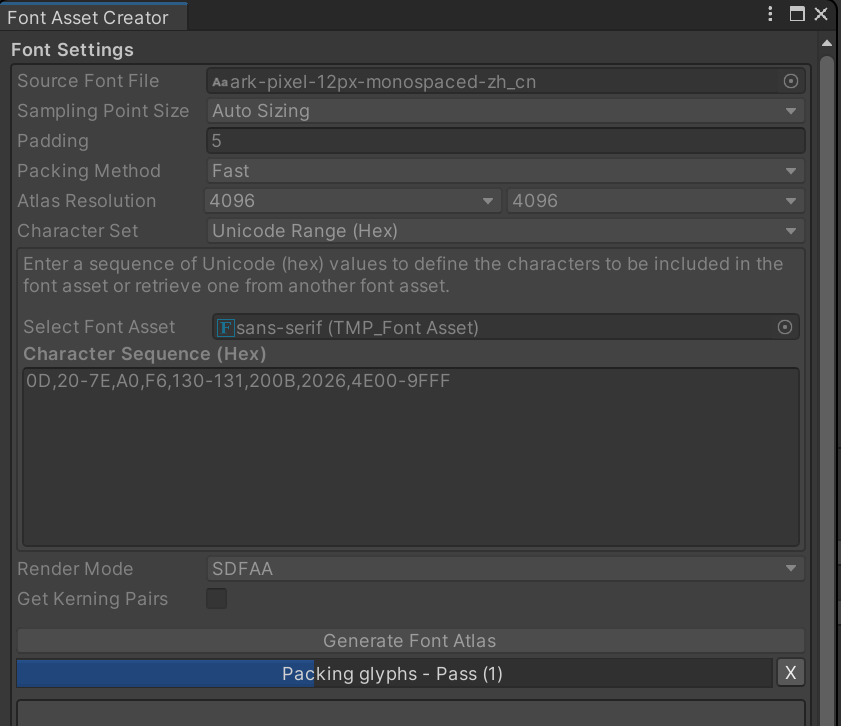
After that, CSS font-face rule can be used to assign a name to that font asset to be used as a font-family inside CSS.
This works similar to the standard CSS font-face. A url or resource URL must be given as the src descriptor — local() is skipped, since Unity cannot hand out a system font as a font asset.
@font-face {
  font-family: "My Custom Font";
  src: resource("Fonts/my-custom-font/cyrillic");
}

:root {
  font-family: "My Custom Font";
}
This is also how ReactUnity defines the default font internally.
Declaring the weights of a family
A font asset holds one weight, so a family that has several is several assets. Write one @font-face per asset, all under the same font-family, and say which weight or slope each one covers.
@font-face {
  font-family: "Inter";
  src: resource("Fonts/Inter-Regular");
}

@font-face {
  font-family: "Inter";
  font-weight: 700;
  src: resource("Fonts/Inter-Bold");
}

@font-face {
  font-family: "Inter";
  font-style: italic;
  src: resource("Fonts/Inter-Italic");
}
From then on font-weight and font-style pick between them, so a heading or an emphasised run gets the drawn face rather than TextMeshPro’s synthetic bold and skew:
:root {
  font-family: "Inter";
}

h1 {
  font-weight: bold;
}
A weight with no face of its own takes the nearest declared one, so a family with only a regular and a bold face still answers font-weight: 500.
Falling back for missing glyphs
No single font covers everything, and a font asset draws a missing character as a box. font-family takes a list for this reason: the first font that loads draws the text, and the ones after it cover the characters it has none of.
:root {
  font-family: "Inter", "Noto Sans CJK", "Noto Color Emoji", sans-serif;
}
A name that no @font-face declares is skipped, so the list is also how one stylesheet can name a font that only some builds ship.